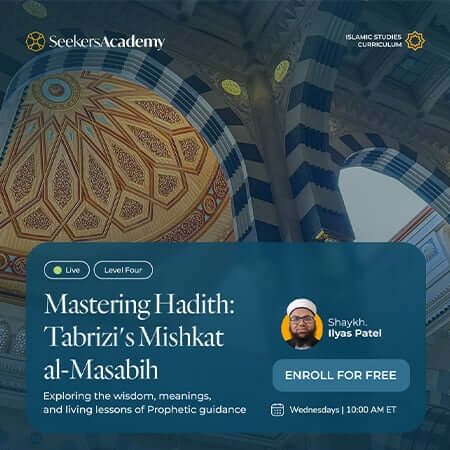
This course offers a study of Mishkat al-Masabih, a key comprehensive reference in Hadith science over several academic terms. Aimed at students and researchers, it seeks to deepen understanding of the Prophet’s sayings, their meanings, and applications drawing from the authentic and widely accepted sources of the Muslim scholarly tradition.
The course connects Hadiths to legal, ethical, and social dimensions and rulings, helping learners grasp the place of Hadith within Islamic scholarship under the guidance of a qualified teacher.
- Teacher: Mawlana Ilyas Patel
Mishkat al-Masabih is one of the comprehensive works that covers most of the subjects of the Prophetic Hadith. It is classified among the works arranged by jurisprudential chapters but without full chains of transmission, and it is considered one of the books of legal evidences (dalā’il al-aḥkām). It gathers the majority of Hadiths related to legal rulings across all jurisprudential schools. Within it, the researcher finds a large collection of Hadiths and reports that are rarely combined in a single book. It has enjoyed more benefit and acceptance than its source (Maṣābīḥ al-Sunnah by al-Baghawī). Scholars have received it with great interest, teaching it, explaining it, annotating it, abridging it, and translating it.
Its commentaries are highly valuable, since they often explain Hadiths not found in other commentary works of the canonical Hadith collections. The book is easy for laypeople and beginners to read, while also offering specialists and students of knowledge access to a wide range of evidences for rulings. This accessibility was one of the main reasons for its spread in the Eastern Islamic world generally, and in the Indian subcontinent in particular. Scholars there would often reference it in their writings due to the great attention and attachment people had to it, until it became one of the standard texts taught in religious schools in the Indian subcontinent.
More than fifty works have been written on Mishkat al-Masabih, including commentaries, annotations, completions, abridgments, and translations.
This course is primarily intended for advanced students of Islamic sciences, and secondarily for the wider Muslim community, particularly those studying or interested in the deeper understanding of hadith and science of Hadith.
It is designed for students who have already completed the foundational texts in Hadith studies and who wish to deepen their understanding of Prophetic traditions, their legal and educational meanings, and their implications for deriving rulings.
- Accurate preservation of the wording and narrations of the Prophetic Hadiths.
-
Understanding the general meaning of these noble Hadiths.
-
Deriving the benefits, guidance, and legal rulings indicated by these Hadiths.
-
Grasping the linguistic subtleties and Hadith-related nuances.
-
Attaining the blessing of reciting the words of the Messenger of Allah ﷺ.