

The course on the "Book of Prophetic Ethics and the Courtesies of Living" (Kitab Adab al Ma'isha wa Akhlaq al-Nubuwwa) is a study of a classic Islamic text written by Imam Ghazali. The book, "Adab al Ma'isha wa Akhlaq al-Nubuwwa," focuses on two main areas: ethical conduct in daily life and the moral qualities exhibited by the Prophet Muhammad. It combines practical guidance for individuals on how to live an ethical and virtuous life with insights into the exemplary character of the Prophet Muhammad (Blessings and Peace be upon Him).
This course offers participants the opportunity to explore and internalize the teachings of the "Book of Prophetic Ethics and the Courtesies of Living," enabling them to cultivate virtuous character traits and incorporate the Prophetic example into their daily lives.
- المعلم: Shaykh Faid Mohammed
- المعلم: Shaykh Faraz Rabbani
Book 20 Of Ihya ulum al-din: In the Book of Prophetic Ethics and the Courtesies of Living (Kitab Adab al ma’isha wa-akhlaq al-nubuwwa), book twenty of the forty books which compose the Revival of the Religious Sciences (Ihya’ ‘ulum al-din), Abu Hamid al-Ghazali gives a full account of the customs and character of the Final Messenger, Muhammad (Blessings and Peace be upon Him). It is not a biography of Prophet Muhammad (Blessings and Peace be upon Him) but a roadmap for those who want to strengthen their faith, increase their knowledge and deepen their understanding of the second part of the testimony of faith, namely the first pillar of Islam.
The author details the Messenger’s noble nature and his miracles while removing doubts regarding his message. He deals with the issue of the imitation of the Prophet (Blessings and Peace be upon Him) noting that the ultimate source of knowledge is a revelation from Allah - The Exalted, which comes to us through the Messenger. The messengers of God are not merely sources of law that aim to govern the body; indeed they are a fount of spiritual nourishment for the soul, the heart and the mind. This volume lays clear that the aim of the imam in this Series is to call for a return to the Sunnah and the imitation of the Messenger in all aspects of life.
The focus is on the acts which directly influence the heart; he provides the reader with the necessary knowledge that makes up the path leading to the Hereafter. Al-Ghazali concludes that for him the truth and validity of the revelation is verified by the moral influence it exercises on the heart, mind and ultimately on the soul.
-
This course is for students pursuing Islamic studies at various levels, including high school, college, and university. It would provide them with a deeper understanding of ethical conduct and the virtues demonstrated by the Prophet Muhammad (pbuh).
-
Teachers at Islamic schools and institutions can incorporate the principles from this course into their curriculum. This would help students understand the importance of ethical conduct and how it aligns with Islamic teachings.
-
Youth organizations and programs can use this course to engage young Muslims in discussions about ethical behavior, character development, and the relevance of these teachings in their lives.
-
Adults in various professions can benefit from learning how to incorporate Prophetic ethics into their workplaces and interactions. The course can offer insights into maintaining ethical standards in challenging situations.
-
Anyone interested in personal growth and character development can take this course to learn from the example of the Prophet Muhammad (pbuh) and implement his teachings in their lives.
-
Non-Muslims interested in learning about Islamic ethics and the teachings of the Prophet Muhammad's (pbuh) character can also benefit from this course to foster understanding and respect.
- Gain a deep understanding of the ethical teachings and virtues demonstrated by the Prophet Muhammad (pbuh) by applying the principles studied to real-life situations, demonstrating the ability to make ethical decisions.
- Identify and differentiate between virtuous qualities and negative traits in light of Islamic teachings and life of the Prophet (pbuh) understanding the greatness He (pbuh) was bestowed with.
- Establish a deeper spiritual connection through understanding how ethical conduct is tied to one's relationship with Allah.
- Synthesize theoretical knowledge with practical implementation, aligning one's actions with the teachings studied.
- Advocate for positive societal change by embodying and promoting ethical behavior in the broader community.
- Cultivate self-awareness and empathy toward others, fostering positive relationships and effective communication.
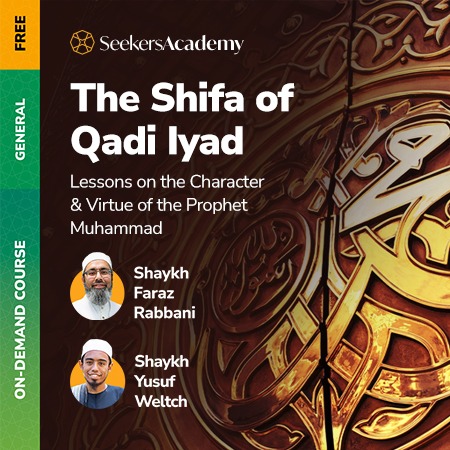
This course covers the famous work - The Shifa - by the great scholar of Islam, Qadi Iyad. The book discusses the blessed person and life of the Prophet Muhammad (peace be upon him) from many different vantage points. Along with this, the author adds many other crucial issues that the Believer needs in their relationship with Allah and His Messenger.
Without having deep knowledge and understanding of the Prophet Muhammad (peace be upon him), it because increasingly difficult to emulate him and given him the due reverence that a true role model deserves. For this reason, studying about the Prophet and his life proves to be the most effective means in repairing that ever-important connection between the Believer and the Prophet.
The diligent student will take from this course a broad and deeper understanding of the Prophet (peace be upon him), his status, his importance, and need of every Believer to love and follow Him. The student will also become familiar with the details of key events that took place in the life of the Prophet such as his birth, his night journey, his ascension, and more.
- المعلم: Shaykh Faraz Rabbani
- المعلم: Shaykh Yusuf Weltch
- A deeper understanding of who the Prophet Muhammad (peace be upon him) is.
- Deeper insight into key events in his life (peace be upon him)
- A deeper knowledge of the true status of the Prophet (peace be upon him)
- A sense of love and reverence for the Prophet (peace be upon him).

“My brother – you’ll not attain true knowledge except through six things. I shall tell you about them in detail. Intelligence, a burning desire, poverty, a humbled self, the instruction of a skilled teacher, and the passage of a long time.”– Imam Juwayni.
These lines summarize the advice of one of the great scholars of Islam to students of knowledge. It has been a tradition of scholars to not only teach students what to learn but how to learn.
Some matters remain the same for any seeker of knowledge, such as the central importance of proper conduct and respect. Others may change in different times and places, such as managing part-time studies, work, and family duties.
Join Shaykh Ahmad Saad al-Azhari and Shaykh Faraz Rabbani as they beautifully explain the proper mindset, internal state, and outward manners required by the student, as well as how to avoid common pitfalls. Starting with humility to the teacher and to the approach of study, this course links the inward, outward, and practical aspects needed to make seeking sacred knowledge the noble act of worship it is.
- المعلم: Shaykh Faraz Rabbani
- المعلم: Shaykh Ahmed Saad Al-Azhari
At the end of the course, students will be able to:
- Learn the proper manners of seeking knowledge.
- Realize the importance of humility to the teacher and to the approach of study.
- Understand how to beautify their internal state in order to gain beneficial knowledge.
- Avoid common pitfalls in seeking knowledge.
- Transform their seeking of knowledge into the noble act of worship it is.
